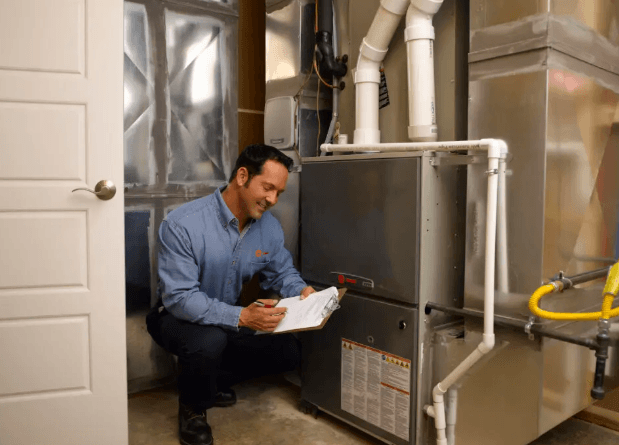

A licensed home daycare that bills twelve slots can lose the whole day’s revenue because the playroom reads 62 degrees at nine in the morning. The argument here is simple: for a home-based program, an unreliable furnace is a revenue problem, and the only thing that ends it is a repair on the part that actually failed. One operator licensed for 12 children in a 1,600 square foot Gig Harbor rambler searched heating gig harbor wa during drop-off, after her third morning of walking down to the utility closet to hit a reset button. Three comfortable beliefs had kept her in that loop, and none of them held up.
Warm Air Does Not Mean A Healthy Furnace
Myth one says that if the registers blow warm, the equipment is fine. Warm air only proves the burners lit. Whether they stay lit through a full cycle is a separate question, and it gets answered by the flame sensor, the pressure switch and the high limit. On a furnace that runs beautifully at 6 a.m. and quits by 10, what usually turns up is a flame sensor coated in a film you can wipe off with a dollar bill, or a condensate drain backing up into the inducer housing. Neither part costs much. What they will do is shut the system down deliberately, because that lockout is a safety feature working exactly as designed.
Short Cycling Is Not A Thermostat Quirk
Myth two blames the thermostat, and it is the priciest of the three, because a new thermostat costs real money and fixes nothing. Short cycling usually means the furnace is overheating and tripping its high limit, and restricted airflow is the common cause: a filter months past its date, closed registers in rooms the kids never use, a return grille with a toy shelf pushed against it. Here is the rule worth memorizing. If the burner runs under eight minutes and relights within five, stop shopping for thermostats and have the airflow measured. If it finishes full cycles and only fails during the coldest hours before sunrise, look at ignition and fuel supply instead.
Waiting Until Spring Costs More Than The Repair
Myth three is that a January repair can wait for spring pricing. Put a lost morning on paper first. Say the program bills 45 dollars a day per child and nine of twelve slots are filled that Tuesday, which is 405 dollars on the books before the furnace decides otherwise. Most in-home contracts do not prorate a half day, so the loss is the full 405, not half of it. Two mornings like that cost more than the diagnostic and the repair would have on a rambler-sized 80,000 BTU furnace. Then there is the part that never shows up in the arithmetic, which is the parent who quietly starts asking a neighbor about backup childcare.
A second cost hides inside the emergency call itself. ACHR News published a report in July 2026 putting only 65% of a technician’s eight-hour day in billable territory, about 5.7 hours, which explains a good deal of what a single service call has to carry. Drive time, parts runs and paperwork absorb the rest of that day whether the visit happens in October or in a cold snap. Waiting does not shrink the overhead. It moves the appointment into the week when half of Pierce County is calling at once, when the first open slot is Thursday and the diagnostic fee is whatever after-hours costs.
Questions Daycare Operators Ask Before Calling
What Do I Do If The Carbon Monoxide Alarm Sounds During Nap Time?
Get every child and adult outside into fresh air, then call 911 from outside. Do not go back in to open windows or look at the furnace, and keep a combustion furnace you suspect of spilling turned off until a technician has tested it and cleared it. The U.S. Fire Administration recommends that any household with a fuel-burning furnace or heater place CO alarms on every level of the home and in a central spot outside each separate sleeping area, which in a licensed home means the nap room is included.
Can We Just Run Space Heaters Until The Furnace Is Fixed?
For one afternoon, maybe. As a plan, no: a pair of 1,500 watt heaters on a shared 15 amp circuit in an older rambler is how an operator learns which outlets share that circuit. Ask your licensor before a portable heater becomes part of the routine, since the rules on open heating elements in a licensed home come from the state and vary by program type.
See also: Tips to Improve Your Business Website Performance
A Reliable Morning Is The Real Measure
The number that matters is not the furnace’s age or its efficiency rating. It is whether the program opens at 6:30 and runs until 5:30 with nobody watching a thermostat. Operators who treat heating Gig Harbor WA as a scheduled maintenance line rather than a January emergency search lose fewer days and spend less across a season, and for a program working with a maintenance budget under 3,000 dollars a year, that is the whole game. Book the diagnostic in the off season. A morning you never have to interrupt is worth more than any invoice you avoided.