
A pouch filling machine is the component that determines how accurately, consistently, and quickly your product actually gets into the pouch, and getting this choice wrong is one of the most common sources of waste, downtime, and quality complaints in packaging operations. This guide explains how different pouch filling machines work, what separates them by product type, and what to evaluate before purchasing, so your filling system matches your product’s actual physical characteristics instead of being chosen on price or general reputation alone.
What a Pouch Filling Machine Does
A pouch filling machine measures and dispenses a precise amount of product into a pouch, either as part of a full form-fill-seal line or as a standalone unit feeding into a separate sealing process. The filling mechanism is arguably the most critical part of the entire packaging line, since fill accuracy directly affects product giveaway costs, regulatory compliance for labeled weights, and overall packaging consistency.
Main Types of Pouch Filling Mechanisms
Auger Fillers
Use a rotating screw (auger) to measure and dispense product by volume, making them well suited for powders and fine granular products like spices, protein powder, or flour. Fill accuracy depends on consistent product density, so auger fillers work best with free-flowing, uniform powders.
Multi-Head Weighers
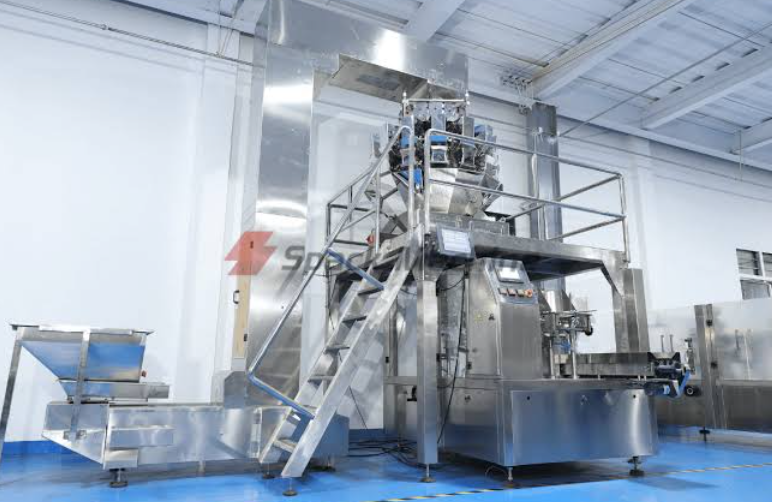
Use multiple weighing heads working in combination to dose product by weight rather than volume, which handles irregularly shaped or inconsistent products, like snack foods, frozen vegetables, or small hardware components, far more accurately than volumetric methods.
Piston Fillers
Use a piston-driven cylinder to dispense a fixed volume of product per cycle, commonly used for liquids, semi-liquids, and viscous products like sauces, creams, or gels where volumetric consistency matters more than weight-based accuracy.
Volumetric Cup Fillers
Dispense product using fixed-volume cups that fill and release in sequence, typically used for free-flowing granular products like rice, beans, or coffee, where speed matters more than the extreme precision offered by multi-head weighers.
Liquid Pump Fillers
Use a metering pump to dispense controlled volumes of liquid, well suited for thinner liquids like beverages, oils, or cleaning solutions where consistent flow rate control is important.
Choosing the Right Pouch Filling Mechanism for Your Product
| Product Type | Recommended Filling Mechanism | Why |
| Fine powders (flour, spice, protein powder) | Auger Filler | Precise volumetric dosing for uniform density products |
| Irregular solids (snacks, frozen produce) | Multi-Head Weigher | Weight-based accuracy regardless of shape |
| Viscous liquids (sauces, gels, creams) | Piston Filler | Consistent volumetric dispensing for thick products |
| Free-flowing granules (rice, coffee, beans) | Volumetric Cup Filler | Fast, cost-effective for uniform granular products |
| Thin liquids (beverages, oils) | Liquid Pump Filler | Controlled flow rate for consistent liquid dosing |
Key Factors to Evaluate Before Buying a Pouch Filling Machine
Fill Accuracy Requirements
Regulatory labeling requirements and customer expectations both drive how tight your fill weight tolerance needs to be. Higher-precision mechanisms like multi-head weighers cost more but reduce product giveaway and compliance risk for tightly regulated products, particularly relevant given weights and measures standards maintained by NIST in the US.
Product Characteristics
Density consistency, flowability, particle size, and viscosity all affect which filling mechanism will perform reliably. A mechanism that works well for one powder may perform poorly with another that has different flow characteristics.
Speed Requirements
Filling speed needs to match the rest of your packaging line’s throughput; a filler that’s too slow becomes a bottleneck, while one that’s excessively fast for your forming and sealing stages adds unnecessary cost.
Cleaning and Changeover
For operations handling multiple products, especially in food or pharmaceutical settings, evaluate how easily the filling mechanism can be cleaned and changed over between product runs to avoid cross-contamination and minimize downtime, consistent with expectations under FDA Good Manufacturing Practice guidelines.
Pouch Filling Process Overview
PassFailProduct Feed/HopperFilling MechanismFill Weight CheckPouch Sealing StageReject/AdjustFinished Pouch Output
Buyer guidance published by industry groups like PMMI generally recommends validating fill accuracy at this checkpoint before scaling to full production speed, while machinery built to safety and quality benchmarks maintained by ISO tends to offer more consistent long-term reliability across filling mechanism types.
Common Buying Mistakes to Avoid
Choosing a Mechanism Based on Speed Alone
A volumetric cup filler might offer faster cycle times, but if your product has inconsistent density or irregular shape, the resulting fill weight variation can create more downstream cost through product giveaway or compliance risk than the speed gain is worth.
Assuming One Mechanism Works for All Product Variations
A filling mechanism validated for one powder or granule doesn’t automatically perform the same way with a similar but differently formulated product. Testing with your actual product sample before committing avoids this common miscalculation.
Underestimating Cleaning and Changeover Time
Operations running multiple products on the same line sometimes discover that cleaning and changeover time between runs is longer than expected, reducing effective throughput below what the machine’s rated speed suggested.
Matching Filling Mechanism to Your Growth Stage
Smaller operations running a single product line often do well with a dedicated mechanism matched precisely to that product, since specialized equipment generally delivers better accuracy and reliability than a multi-purpose system trying to handle several product types. As product lines diversify, some manufacturers consider modular systems with interchangeable filling heads to reduce equipment count, though this flexibility usually comes with a tradeoff in fine-tuned accuracy compared to dedicated mechanisms built for one product type. Weighing this tradeoff against your actual production mix, rather than defaulting to modularity for its own sake, generally leads to a more cost-effective long-term equipment strategy.
See also: Tips to Improve Your Business Website Performance
Choosing the Right Pouch Filling Machine for Your Line
The right pouch filling machine comes down to matching mechanism type to your product’s specific density, flowability, and viscosity characteristics, then confirming that fill accuracy, speed, and cleaning requirements all align with your production needs. Whether that means an auger filler for fine powders, a multi-head weigher for irregular solids, or a piston filler for viscous liquids, testing with your actual product before purchasing remains the clearest way to confirm the equipment will perform reliably at full production scale.