
Deferring pavement maintenance is a spending decision dressed up as a savings decision. Boards that finally price the sealcoating Brentwood TN contractors will stand behind, after four budget cycles of skipping it, usually find they were financing a repave the whole time, one quiet year at a time. The escalation is documented: a February 2026 breakdown of deferred maintenance from PropFusion, written for reserve study planning, puts full reconstruction at 3 to 5 times the cost of the repair that was postponed. The argument here is blunt. Sealing shared lanes on a schedule costs a 60-home association less than the reconstruction that deferral eventually buys, and it does that while dues stay flat. What follows is the assumption most treasurers walk in with, set beside what the pavement actually does.
Boards Treat Sealcoating As Cosmetic Upkeep
The assumption is that sealer is paint. It makes the lanes look black again before the annual meeting, and if this year is tight, black can wait. What sealer actually does is act as a sacrificial layer over the asphalt binder, the glue holding the aggregate in place. Sun and oxygen pull that binder apart from the surface down, and the process runs whether or not anyone on the board is looking at it. Once enough binder has oxidized, water gets between the stones, Middle Tennessee freeze-thaw swings work the gaps wider, and sealer applied at that point is cosmetics over a structural problem.
Raveling Starts Long Before Lanes Look Bad
Waiting until the lanes look bad is the default policy at most associations, and it is the most expensive habit I run into. Raveling does not announce itself. It begins as a color shift from black to chalky gray, then loose stone along the lane edges, then the gritty spray behind tires that residents track into their garages. By the time damage is obvious from a car window, the association is past sealing and into patching. Google Earth Pro’s historical imagery slider is free and takes about five minutes: pull the aerial of the lanes from six years ago, set it beside the current one, and the gray creep is visible even at that resolution.
See also: Building a Life Rooted in the Land
Coal Tar And Emulsion Are Not Interchangeable
Sealer is not one product, so two bids reading “seal coat” are not necessarily two prices for the same job. The families in common use are refined coal tar emulsion and asphalt emulsion, and they cure differently, wear differently, and price differently. Coal tar has historically held up better against fuel and oil drips, while asphalt emulsion is the usual choice where coal tar is restricted. Those restrictions are local rather than national and vary by state and municipality, so ask which product goes down and confirm with your own city or county before a specification is locked.
Spray Only Work Looks Finished And Wears Thin
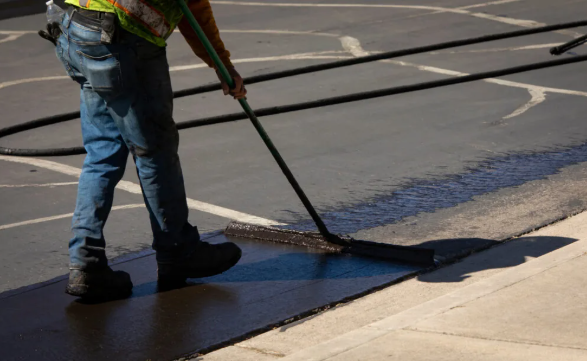
Preparation is where the money either works or evaporates. What we see most often on a lane that failed early is one coat sprayed over a surface nobody cleaned properly: dust still in the pores, oil spots unprimed, cracks left open. It photographs beautifully for the newsletter and starts showing old gray through the wheel paths inside eighteen months. A real job blows and wire-wheels the surface, primes the oil spots so the sealer bonds, fills cracks wider than a quarter inch, and puts down two coats instead of one. That second coat is the first thing cut when a board shops on price alone, and it largely decides whether the work lasts three years or seven.
Reserve Math Rewards Sealing On Schedule
Run the arithmetic on a 60-home association carrying a $14,000 annual pavement reserve line and roughly 38,000 square feet of shared drive lanes. Say sealing runs about $0.20 a square foot in this market and crack filling adds $1,200 on a typical cycle, which puts the work near $8,800 every third year, or roughly $2,900 a year averaged against that line. The reserve absorbs it without a dues increase and still leaves room for striping and the odd patch. Now defer it. Four skipped cycles is twelve years of ultraviolet exposure and freeze-thaw with nothing protecting the binder, and at some point the lanes stop being a surface problem and become a base problem. Say a mill and overlay lands at $4.00 a square foot, illustrative rather than quoted, and the same 38,000 feet comes to about $152,000, which is eleven years of the entire reserve line spent in one summer.
Split across 60 homes, that is a special assessment near $2,500 a door, arriving in a single letter nobody saw coming. A reserve line only protects an association if the work it funds actually happens on time. Boards rarely decide to repave early; they decide to skip one year, four separate times, and by year twelve the cheap options have left the table. The treasurer who held dues flat is the one whose name is on the assessment notice.
Protecting Pavement Beats Repaving Ten Years Early
Pavement is one of the few association assets where the maintenance decision and the capital decision are the same decision, separated by about a decade. Sealing on a published schedule, surface cleaned and two coats down, is the cheaper half of that pair by a wide margin, and it is the half a board actually controls. Boards that put a sealcoating Brentwood TN crew on a three-year rotation are not buying curb appeal; they are buying the right to leave the reserve line alone. Residents will notice the black lanes, which is the least interesting reason to do the work.