
Marcus had the whole Saturday mapped out. New bottom seal, fresh nylon rollers, a $40 torsion spring kit and a pair of winding bars sitting in an online cart, all because the 16-by-7 door on his 1990s tract house let go at two in the morning and woke the dog. He had rebuilt a dishwasher pump and re-hung a storm door off written guides, so the spring looked like the next line on the list. Three of those four jobs were genuinely his. The fourth is why homeowners in that neighborhood end up searching garage door spring repair aurora co before the coffee finishes, and it has nothing to do with nerve. A wound torsion spring is a different class of hazard than a worn roller, and the guide he was following never said so.
So here is the argument, stated flat out. The tune-up, the sensors, the seal and the track work on a DIY list are all yours to do, and the wound spring is the one line item worth handing to a dispatched technician. This piece is about the mistakes that cluster around that single component. The ones that cost you an afternoon are not the problem; the ones that cost you a hand are.
A Wound Spring Holds More Energy Than Expected
An insulated 16-by-7 sectional door weighs somewhere around 130 to 160 pounds. The opener does not lift that weight. The spring on the shaft above the door does, by storing the energy needed to raise the door and giving it back on the way up. Wind that spring seven and a half turns and you have loaded a steel bar with force that has nowhere to go except into whatever is holding it.
DASMA, the association representing door and opener manufacturers, publishes one flat rule for the whole trade: torsion springs store hundreds of pounds of force, and adjustment, repair or replacement should be handled only by a professional technician trained in proper spring handling, because improper work can cause serious injury or death. Take that literally. Never put a screwdriver, a length of rebar or a socket wrench into a winding cone, because the wrong tool slips and the cone unwinds through your forearm. Never work under a door held up by nothing but a spring; clamp the track and set the door down on the floor first. A broken spring does not mean the shaft is safe either, since the second spring on a shared shaft can still be fully wound.
The injury numbers are not dramatic. They are just steady. A January 2026 paper in the American Journal of Emergency Medicine went back through a decade of national emergency room sampling and put automatic door injuries at an estimated 38,720 emergency department visits, with upper extremity injuries showing up in 44.7 percent of adult cases. Hands and forearms, in other words, which is the anatomy that ends up directly in front of a winding cone.
Matching A Replacement Spring By Eye Goes Wrong
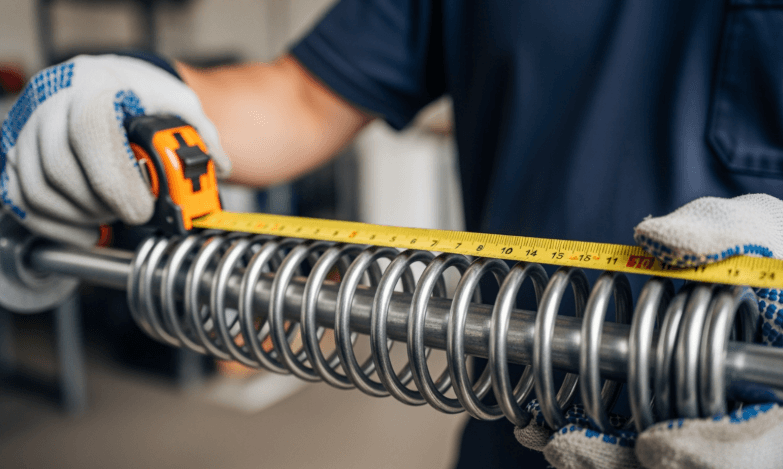
Springs are not generic. A replacement has to match wire diameter, inside diameter, overall length and wind direction, and on a shared shaft carrying two springs the pair has to be balanced against what the door actually weighs. Wire size gets measured across twenty coils with a tape and a bit of arithmetic, never guessed off a photograph. Get one of those four wrong and the door either refuses to stay down or refuses to stay up, and the spring burns through its rated cycles in a fraction of the time.
Job after job, the same thing turns up: a kit ordered off the door’s width and height alone, because those are the two numbers a homeowner already knows. A landlord with a duplex off Chambers Road did exactly that last winter. He worked from a listing photo, spent two weekends on it, and the second spring he bought was wound the wrong direction for its side of the shaft. The $40 kit became $80 plus a service call anyway, which is roughly what the same-day call in the low hundreds would have covered on the first morning.
That arithmetic is why the search for garage door spring repair aurora co so often happens after the parts have already arrived. Nobody enjoys paying twice for one repair. A technician shows up with spring charts, a rack of wire sizes and bars actually sized to the cone, and the measuring takes about as long as reading this paragraph.
Four Questions To Ask Before Anyone Winds A Spring
Hiring the spring out does not mean handing over your judgement. A good shop answers plainly and a vague one starts talking around the question, and that difference shows up inside the first two minutes of the phone call. Ask these before anybody touches the shaft.
- What wire size and length are you putting on this door, and how did you arrive at it? A good answer names measurements taken at the door itself, not a number pulled from the model.
- Are you replacing both springs on a shared shaft, or only the one that broke? A good answer explains that the surviving spring has the same cycle history and is usually months from failing too.
- What cycle rating am I getting, and what does the high-cycle upgrade cost? A good answer quotes a 10,000-cycle standard spring against a 25,000-cycle one in dollars.
- Is the technician your employee or a subcontractor, and who carries the warranty? A good answer names one company for both.
Any of those answered with a shrug is worth a second quote. (I have hung up on shops for less, and never once regretted it.) Price matters, of course. On a spring the fit matters more, because a mismatched spring is a repeat visit you end up paying for twice.
Know Which Half Of This Job Is Yours
Here is the split worth remembering. Yours: lubricating hinges and rollers with a proper garage door lubricant, tightening the lag bolts on the track brackets, replacing the bottom seal, wiping and realigning the photo eyes when the door reverses for no reason, and testing the balance by pulling the release and lifting the door halfway by hand. Theirs: anything on the shaft, anything near the cone, anything with a cable under load. That line is not about skill level, it is about stored energy and the tooling required to release it safely.
Marcus cancelled the spring kit and kept the rollers and the seal. He did his own tune-up that Saturday, had a technician on the shaft Monday morning, and the door has run quiet ever since. None of that is a story about backing down from a repair. It is about knowing that one component on an old tract garage stores more energy than anything else in the building, and that the step-by-step guide open on your phone probably never mentioned the winding cone at all.